
How to Fold a Fitted Sheet: The Sleep Foundation Method
This post contains affiliate links. As an Amazon Associate, we earn from qualifying purchases.
To fold a fitted sheet neatly, start by laying it face-down on a flat surface like a mattress or table. Tuck the bottom corners into the top corners on the same side, then follow your preferred folding method. For example, the Sleep Foundation recommends folding into thirds twice and then in half, while others suggest folding into a rectangle or square.
The fitted sheet’s elastic edges make it spring back when you try to fold it like a flat sheet. That’s why most people end up with a crumpled ball in their linen closet. But three methods from laundry experts can simplify this chore, including a clear method for how to fold a fitted sheet.
What follows: the Sleep Foundation’s letter method (best for quick folding), Martha Stewart’s corner technique (most precise), and Philips’ iron-and-fold system (for wrinkle-free results). Each works for standard and deep-pocket sheets when you learn how to fold a fitted sheet, the difference is in the first three steps.
Key Takeaways
- Sources like the Sleep Foundation recommend starting with the sheet face-down on a mattress or table, elastic edges up, while Martha Stewart starts with the sheet inside out.
- Tuck bottom corners into top corners using the pocket method or Martha’s fold-over technique
- The Sleep Foundation recommends folding into thirds twice, then in half, while other sources suggest different final shapes like a rectangle or square.
- Store folded sheets inside a pillowcase to keep sets together (The Spruce)
- Replace sheets weekly to maintain sleep hygiene (Sleep Foundation)
The Sleep Foundation Letter Method
This approach turns a fitted sheet into a neat rectangle in six steps. It’s the fastest method when you’re folding multiple sheets after laundry day.
-
Lay the sheet face-down on a mattress, table, or clean floor. The elastic edges should face upward. Smooth out any wrinkles with your hands, this prevents creases in the final fold.
-
Tuck the corners:
- Find one bottom corner and tuck it into the pocket of the top corner on the same side
- Repeat with the other bottom corner
-
The sheet now forms a half-size rectangle with all elastic hidden
-
First fold into thirds:
- Bring the left edge two-thirds across the sheet
- Fold the right edge over the left to complete the third
-
Smooth the layers to keep them flat
-
Second fold into thirds:
- Fold the bottom edge two-thirds up the sheet
- Bring the top edge down over the bottom
-
You now have a long, narrow rectangle
-
Final fold in half to create a compact square
Note on moisture: The Sleep Foundation recommends folding dry sheets to prevent wrinkles, while Philips suggests removing sheets while slightly damp if you plan to iron them.
Martha Stewart’s Corner-Folding Technique
Martha’s method focuses on perfect corner alignment. It takes slightly longer but produces the neatest folds for linen closet display.
- Stand holding two adjacent corners of one short edge, sheet inside-out
- Fold right corner over left so the top corner is right-side out
- Grab the hanging third corner (adjacent to the right) and fold it over the first two
- Bring up the last corner and fold it right-side out over the others
- Lay the bundle flat and fold edges inward to hide all elastic
- Fold into a rectangle, adjusting size to match your storage space
The sequential corner-folding prevents bulky overlaps.
Store folded sheet sets inside one of their pillowcases to keep everything organized, a trick from The Spruce’s linen closet guide. This also protects them from dust between uses.
Philips’ Iron-and-Fold System for Wrinkle-Free Sheets
For those who prefer crisp, hotel-quality folds, Philips combines ironing with precise folding:
- Remove sheets slightly damp from the dryer
- Fold lengthwise into quarters, aligning opposite corners
- Iron the top corners and center to remove wrinkles
- Fold horizontally to align bottom corners with top
- Tuck elastic corners together to prevent separation
This method takes longer but can eliminate wrinkling better than folding alone. Use it for formal bedding or when storing sheets long-term.
Storing Folded Sheets
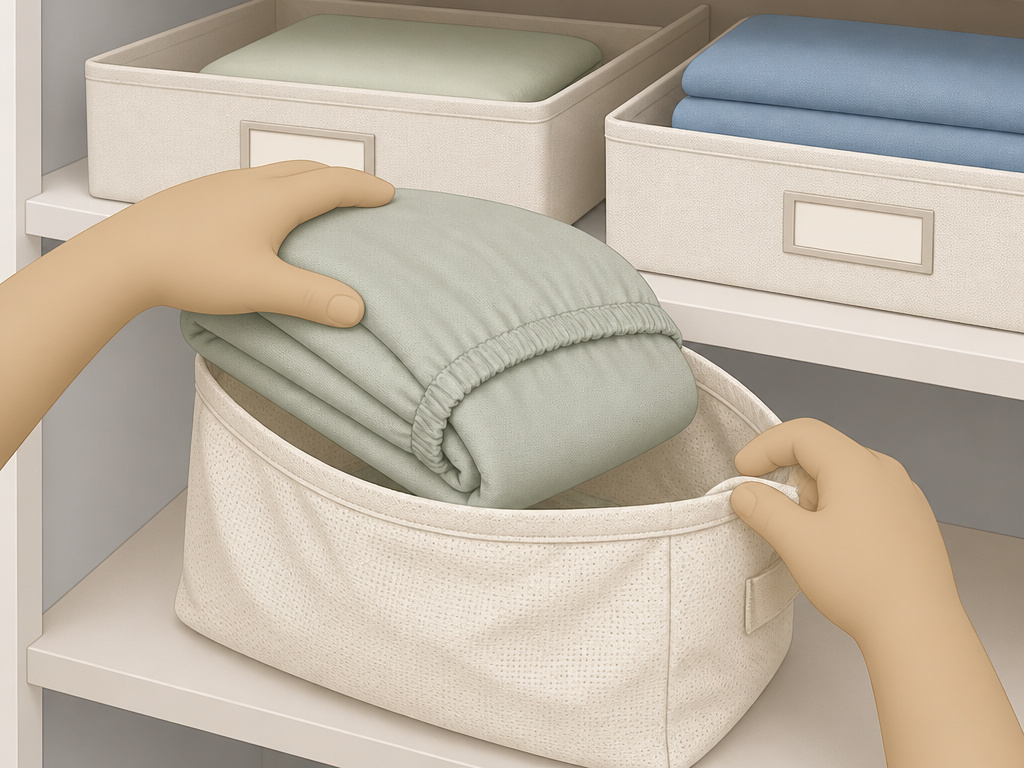
However you fold them, proper storage keeps sheets fresh:
- Use breathable cotton bags instead of plastic bins or vacuum seals
- Rotate two sheet sets per bed to extend fabric life (Sleep Foundation)
- Keep linen closet shelves shallow to prevent over-stacking.
- Store by bed size with labels if you have multiple sets
The New York Times interactive folding guide shows visual comparisons of these methods, helpful when learning the corner sequences.
Frequently Asked Questions
Why won’t my fitted sheet corners stay tucked?
Elastic fatigue is the usual culprit. Try Martha Stewart’s corner-folding method instead of pocket-tucking, or consider replacing worn sheets.
How do you fold extra-deep fitted sheets?
Flip the elastic edge inward before folding to shorten the pocket. Some extra-deep sheets may require adjusting the folding method.
Should sheets be folded right after drying?
The Sleep Foundation recommends folding dry sheets immediately to prevent wrinkles. Philips suggests folding slightly damp sheets if you plan to iron them.
What’s the best way to store sheet sets?
Fold matching sets together and store them inside one of their pillowcases, it keeps everything organized and dust-free.
The Bottom Line
All three methods work, but choose based on your priority:
- Speed: Sleep Foundation’s letter method – Precision: Martha Stewart’s corner technique – Wrinkle-free: Philips’ iron-and-fold system
Whichever you pick, mastering how to fold a fitted sheet the same way every time builds muscle memory and makes it faster with practice. And skip the “balled up in a closet” approach, neatly folded sheets actually save space.
