
10 Best Pillows For Pressure Point in 2026
This post contains affiliate links. As an Amazon Associate, we earn from qualifying purchases.
Our best overall pick for pressure point relief is the Purple Harmony GelFlex Grid Pillow for its targeted support and consistent cooling. We also highlight the Mellow CloudAlign Memory Foam Pillow for its ergonomic contour and the Contour Legacy Leg Support Pillow for hip alignment.
If you wake up with neck or shoulder pain, the right pillow can make a significant difference. Pressure point pillows use specific shapes and materials to reduce strain on sensitive areas like the neck, shoulders, and hips. This guide is based on research into specifications, expert round-ups, and patterns in owner feedback to help you find a pillow that provides genuine relief.
Top 10 Pillows For Pressure Points in the Market
Certain content that appears on this site comes from Amazon. This content is provided "as is" and is subject to change or removal at any time.
The Best Pillows For Pressure Points, Reviewed
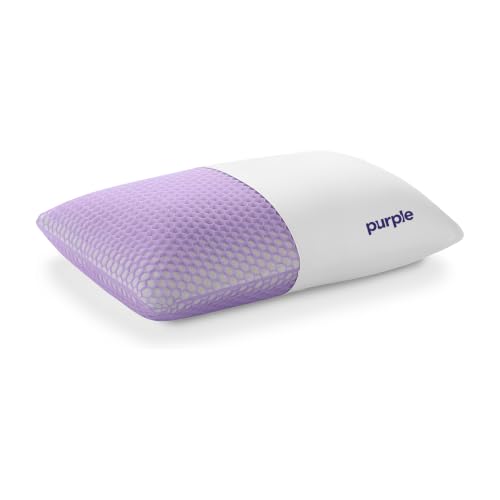
Purple Harmony GelFlex Grid Pillow
What We Like
- GelFlex Grid and latex ease pressure points
- Three lofts target specific sleeping positions
- Temperature-balancing materials for cool sleep
- Holds shape without fluffing or flattening
Trade-offs
- Lowest loft (5.5") may not suit all side sleepers
- A single, tuned medium feel offers no soft or firm variants
A honeycomb GelFlex Grid paired with Talalay Latex foam creates a pressure-relieving cradle for your head, neck, and shoulders. This design aims to ease restlessness so you can settle in. The Harmony comes in three distinct heights to match your posture. The 5.5-inch low option suits back and stomach sleepers, while the 6.5-inch medium and 7.5-inch tall versions are favorites for side sleepers who feel shoulder pressure. Its balanced medium feel is supportive without being hard, and the materials are built to hold their shape without constant fluffing.
The Purple Harmony Pillow provides a single, balanced medium feel, which means you don’t choose between soft and firm. Its cooling system uses a GelFlex Grid and aerated Talalay latex to pull heat away, a feature specifically noted for hot sleepers. This construction results from over 30 years of patented innovation, aiming for a weightless, luxury sensation.
Mellow CloudAlign Memory Foam Pillow

What We Like
- Dual height for customizing loft
- Contoured shape targets neck and spine
- OEKO-TEX certified, breathable cover
- Cover is removable and machine washable
Trade-offs
- Fixed contour offers no modular fill adjustment
- 28-inch length requires significant bed space
Designed with a dual height design, this pillow lets you choose between two support levels simply by flipping it over, which matches your sleep position and body type. Its contoured shape and targeted support zones cradle your head and support your neck to promote proper spinal alignment. The responsive memory foam conforms to your natural shape, and the pillow is engineered to adapt to side, back, and stomach sleepers.
The pillow’s form is a fixed contoured shape, unlike designs that allow for adding or removing fill. Compared to other cervical pillows, its 28-inch length is longer than the 24.2-inch Krightlink or the 23.6-inch UTTU model, requiring more bed space.
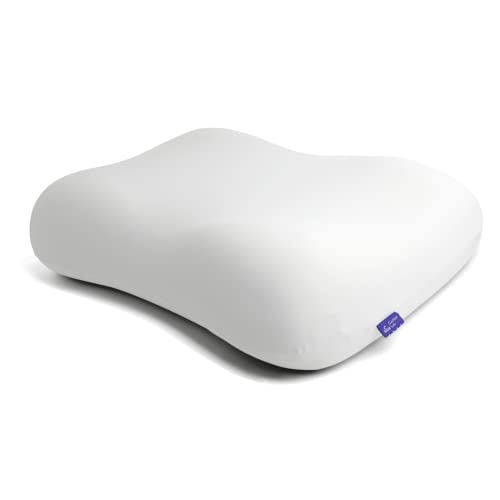
C Cushion Lab Deep Sleep Pillow
What We Like
- Patented contour with sculpted side bolsters and shoulder line
- Dual-density memory foam for adaptive, pressure-relieving support
- Anti-aging pillowcase designed to prevent skin creases and frizz
Trade-offs
- Length is 15.8 inches, shorter than many standard pillows.
- Weighs 4.0 pounds, heavier than some foam pillows.
A patented contour design is the core of this pillow, shaping its entire profile to cradle the head and neck for side and back sleepers. The sculpted side bolsters and sweeping shoulder line are engineered to provide targeted support without pressure points. It suits someone who wants a pillow that actively guides their head into a supported position, using dual-density memory foam for a soft top layer over a firmer foundation. This is for the sleeper seeking a highly structured, orthopedic feel rather than a traditional flat pillow.
The trade-off is its compact footprint. You get focused, deliberate support in a specific zone. For those who sprawl or prefer a larger, more forgiving surface to burrow into, the narrow width and short length will feel restrictive.
Product photos
Contour Legacy Leg Support Pillow

What We Like
- Ergonomic crescent shape fits between legs and knees.
- Ventilated foam promotes airflow for cooler sleep.
- No straps needed; contours and stays put.
- One-year manufacturer warranty for peace of mind.
Trade-offs
- At 10 inches long, it's a dedicated leg positioner, not a head pillow.
- The 0.4-pound weight offers minimal heft; may shift for very active sleepers.
The Contour Legacy’s ventilated memory foam and unique crescent shape are engineered to cradle both your legs and knees. This dual support is the core of its design, aiming to stop your top leg from dropping forward and twisting your hips. For side sleepers who feel that nightly pinch in their back or hips from misalignment, this pillow targets those specific pressure points directly. It’s a focused tool for a specific problem, not a general comfort accessory.
This pillow’s dedicated design is also its main limitation. It serves as a leg positioner, not a head pillow. Its light weight relies on contouring rather than mass to stay in place. For side sleepers experiencing a chain of discomfort from back to knee, its straightforward approach isolates and addresses that specific problem.
Krightlink Ergonomic Cervical Pillow

What We Like
- Dual-height design accommodates various sleeping positions
- Contoured shape supports natural neck and spine curvature
- Removable, breathable silk pillowcase aids hygiene
- Memory foam provides pressure-relieving, durable support
Trade-offs
- Fixed dual heights of 4.4 and 3.75 inches
- Weighs 3.7 pounds
A dual-height contoured design gives this pillow a clear advantage for personalizing neck support. The 4.4-inch and 3.75-inch sides let side and back sleepers fine-tune their alignment without extra inserts or layers. Its slow-rebound memory foam is built for lasting pressure relief, and the included silk pillowcase adds a practical, washable layer.
This pillow’s specific ergonomic intent is its defining characteristic. The pronounced contour and fixed heights work best if you stay in your chosen sleeping position. It compares directly to the **Mellow CloudAlign Memory Foam Pillow**, which offers similar dual-height contouring. For someone who shifts positions frequently or prefers a flatter surface, the adjustable loft of a pillow like the Purple Harmony might be a better fit.
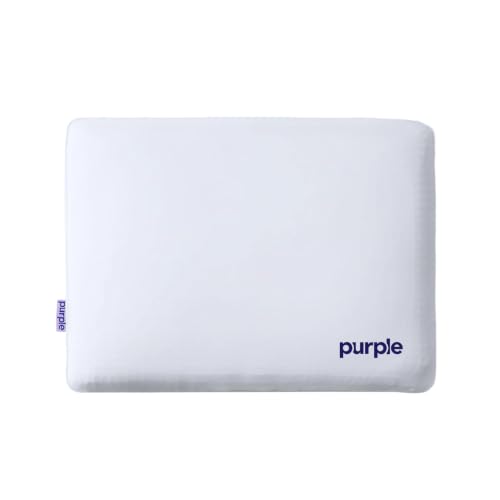
Purple DreamLayer Adjustable Pillow
What We Like
- Adjustable loft suits stomach, back, and side sleepers
- GelFlex Grid provides contouring pressure relief
- Cooling materials promote airflow for hot sleepers
- Removable boosters allow for customizable height
Trade-offs
- At 8.4 pounds, it is heavier than many foam pillows
- Standard size is shorter than the Purple Harmony model
The ability to switch between three distinct heights makes this pillow a standout for sleepers who change positions or haven’t settled on a single loft. Its GelFlex Grid core molds to the head and neck, offering the pressure-relieving contour of memory foam without the heat retention. That combination of adjustability and targeted support is precisely what makes it a prime candidate for anyone whose comfort depends on fine-tuning their pillow’s profile night to night.
At 8.4 pounds, the Purple DreamLayer Adjustable Pillow is heavier than many other bed pillows, including the 1.0-pound Purple Harmony Pillow. Its medium-soft overall sensation is designed for contour-hugging comfort rather than very firm cervical alignment. For a fixed-loft alternative with a similar cooling GelFlex Grid but a more weightless, responsive feel, the Purple Harmony GelFlex Grid Pillow uses latex instead of a foam core.
UTTU Adjustable Cervical Pillow

What We Like
- Adjustable height for precise neck and head alignment
- Foam stays soft in cold temperatures for consistent feel
- Breathable cover promotes cooling throughout the night
- Contour design supports side, back, and stomach sleeping
Trade-offs
- Queen size is narrower than many standard pillows at 14 inches wide
- Maximum loft of 5.2 inches may be too low for some side sleepers
- Contour shape requires commitment to a specific sleeping position
The UTTU pillow’s adjustable loft offers two heights, 5.2 inches and 4.5 inches, to accommodate varied types of sleepers seeking neck pain relief. Its proprietary memory foam is designed to never become hard in cold weather, maintaining consistent firmness year-round. This combination of adaptable support and temperature-stable material suits users who have found other pillows too rigid in winter.
The breathable cover adds a legitimate cooling element, though the pillow’s 14-inch width is noticeably narrower than a typical queen pillow, so it may not suit those who move around a lot. For a sleeper who values a cooler, contour-hugging feel and wants to avoid the seasonal firmness shift of standard memory foam, this is a thoughtful design. If you need a broader surface area, the Mellow CloudAlign offers a similar contour in a wider 15-inch frame, but without the adjustable layers.
Product photos
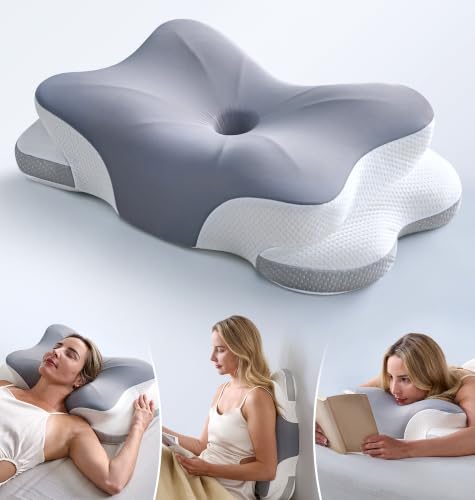
CloudCoz Ultra Pain Relief Pillow
What We Like
- Graphene fabric emits far-infrared energy for circulation
- Hollow-center contour design aligns cervical spine
- Open-cell foam offers three times standard breathability
Trade-offs
- The unique butterfly shape may require adjustment for stomach sleepers.
- Dimensions listed as 14.2 inches long by 6.3 inches wide.
A graphene-infused fabric that emits far-infrared energy sets this pillow apart for those seeking targeted pressure point relief. The material aims to promote circulation directly where your neck rests, which is a specific approach not found in standard memory foam or latex options. Its patented hollow-center contour and butterfly shape are engineered for cervical alignment and extended shoulder support, making it a dedicated tool for side and back sleepers with persistent neck tension. This is a pillow built for a singular, therapeutic purpose.
Its compact 14.2-inch length makes it more of a cervical positioning tool than a traditional bed pillow, so you won’t be burying your face in this one. For a more adaptable pressure-relief experience that still fits a standard pillowcase, the **Mellow CloudAlign Memory Foam Pillow** offers a dual-height, contoured design in a more conventional size. This pillow commits fully to its ergonomic niche, meaning your comfort depends on needing exactly what it provides.
Product photos
Tempur-Pedic All-Purpose Travel Pillow

What We Like
- Peanut shape enables multi-use as neck or lumbar support
- Lightweight and compact for easy travel
- TEMPUR foam provides pressure-relieving support
- Machine-washable cover simplifies maintenance
Trade-offs
- At 11.5 inches square, it is smaller than a standard bed pillow
- Peanut shape is unconventional for full-head sleeping support
Weighing only half a pound, this pillow is fundamentally portable rather than a primary bed pillow. Its compact form trades a full sleeping surface for a shape that slips easily into a bag. The peanut-shaped design and TEMPUR material are intended for pressure relief and alignment while in transit, as described in its all-purpose and travel-focused features.
Its size is a key consideration, with a width listed at 11.5 inches providing a smaller support surface than many dedicated bed pillows. You are buying a targeted tool. For dedicated home use, its small footprint and unique shape may be limiting. According to its marketing, it excels as a versatile, secondary piece for on-the-go comfort.
Product photos
PTtrac Cervical Traction Pillow
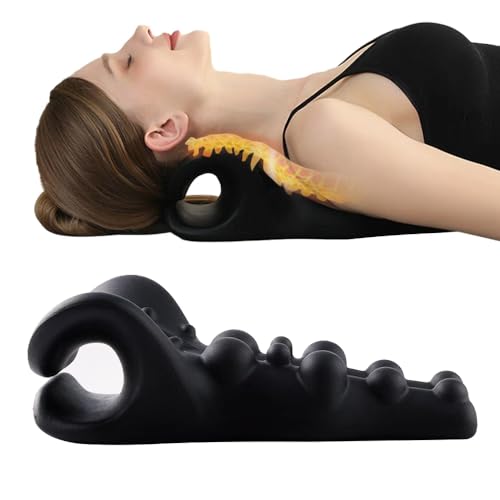
What We Like
- 18 raised nodes for targeted trigger-point massage.
- Firm, high-density foam provides stable cervical traction.
- Designed for short, focused stretching sessions of 3-10 minutes.
- Practical for use after desk work, driving, or workouts.
Trade-offs
- Firm structure is not for overnight sleep or soft comfort.
- Requires a gradual start of 3-5 minutes to adapt.
- Can cause sharp discomfort, numbness, or dizziness if misused.
The 18 raised nodes create a focused pressure-point feel distinctly different from a sleeping pillow. This makes the PTtrac a tool for those who want a firm, targeted massage for the neck and shoulder base after long periods at a desk or behind the wheel. It’s built for a specific, short-duration routine, not all-night support. The high-density foam holds its shape under your weight to deliver a consistent traction-like stretch.
The PTtrac Cervical Traction Pillow delivers a firm, targeted stretch rather than soft cushioning, making it a tool for short daily routines instead of an overnight sleeping pillow. Its 18 raised nodes create a focused trigger-point massage feel ideal for relieving tension after desk work or driving. Users who prefer a gentler start can place a thin towel over the nodes, but the design is intentional for those seeking stronger pressure.
Product photos
How We Evaluated Pillows For Pressure Points
Our research focused on manufacturer specifications, expert round-up recommendations, and consistent patterns in verified owner feedback. We prioritized criteria that directly affect pressure relief: material technology for contouring and cooling, loft height for proper spinal alignment, and shape design for targeting specific pain points like the neck or hips. We also considered practical factors like cover maintenance and warranty length. This evaluation is research-based, so we cannot speak to long-term durability or personal comfort beyond what the data and feedback patterns indicate.
What To Look For In Pillows For Pressure Points
Choosing a pillow for pressure relief means matching its design to your specific pain points and sleeping position. The right combination of material, loft, and shape can prevent morning stiffness and improve alignment.
Look for a pillow that contours to relieve pressure without trapping heat. The correct loft keeps your spine neutral, and specialized shapes target areas like the neck, shoulders, or hips.
Material & Pressure Relief
The pillow’s core material determines how it conforms to and supports your body. Memory foam is a common choice for pressure-relieving foam pillows as it molds closely to the neck and shoulders, distributing weight to reduce peak pressure points. Advanced materials like Purple’s GelFlex Grid or graphene-infused fabrics aim to combine this contouring with enhanced airflow or circulation benefits. For those who sleep hot, cooling gels or ventilated foam designs are critical to prevent heat buildup, which can exacerbate discomfort.
Loft & Sleeping Position
Loft, or pillow height, is crucial for keeping your head and neck aligned with your spine. Side sleepers generally need the highest loft, often between 4.5 and 6 inches, to fill the space between their head and shoulder and prevent lateral neck strain. Back sleepers need a medium loft to support the natural curve of the cervical spine, while stomach sleepers need a very low, almost flat pillow to avoid hyperextending the neck. Many orthopedic pillows offer dual-height designs or removable inserts to help you dial in this measurement.
Shape & Targeted Support
Specialized shapes are engineered to address specific pressure zones. A cervical contour pillow supports the natural curve of your neck, while a pillow with side bolsters can cradle the head and prevent it from rolling off support. For hip and leg pain, a crescent-shaped leg pillow keeps the knees separated and the spine aligned, which is a key principle in pillow positioning for side sleepers. These designs are distinct from general-use pillows and are best for focused relief.
- Measure from the base of your neck to the point of your shoulder to estimate your needed loft.
- Check if the pillowcase is removable and machine-washable for hygiene.
- Consider a trial period if available, as pressure relief is highly personal.
A pillow that targets your primary pain point and suits your main sleep position will offer the most effective relief.
Pillows For Pressure Points Compared
Use the comparison table below to quickly see how our top picks differ in key features like material, loft, and best sleeping position.
| Product | Core Material | Cover | Weight |
|---|---|---|---|
| Purple Harmony GelFlex Grid Pillow | GelFlex Grid and Talalay Latex | Machine-washable, moisture-wicking | 1.0 Pounds |
| Mellow CloudAlign Memory Foam Pillow | Responsive memory foam | OEKO-TEX certified, washable | 4.0 pounds |
| C Cushion Lab Deep Sleep Pillow | Dual-density memory foam | Anti-wrinkle, anti-frizz, washable | 4.0 Pounds |
| Contour Legacy Leg Support Pillow | Ventilated memory foam | N/A | 0.4 Pounds |
| Krightlink Ergonomic Cervical Pillow | Slow-rebound memory foam | Removable, silk-fabric, machine washable | 3.7 pounds |
| Purple DreamLayer Adjustable Pillow | GelFlex Grid and MicroAir Foam | Washable, moisture-wicking | 8.4 Pounds |
| UTTU Adjustable Cervical Pillow | UTTU DYNAMIC FOAM memory foam | Breathable, machine washable fabric | 3.0 Pounds |
| CloudCoz Ultra Pain Relief Pillow | N/A | N/A | N/A |
| Tempur-Pedic All-Purpose Travel Pillow | TEMPUR memory foam | Machine-washable | 0.5 Pounds |
| PTtrac Cervical Traction Pillow | High-density polyurethane foam | N/A | 1.2 Pounds |
Frequently Asked Questions
What kind of cushion can I sit on to relieve pressure?
For seated pressure relief, specialized cushions are designed to redistribute weight away from the tailbone and hips. Look for options with a central cut-out or groove for the coccyx, made from materials like memory foam, gel, or alternating air cells that promote circulation and reduce peak pressure points during prolonged sitting.
What type of cushion is best for pressure sores?
The best cushions for preventing or managing pressure sores depend on the user’s risk level and mobility. For higher-risk situations, alternating air cushions or advanced foam technologies that actively redistribute pressure are often recommended, while gel or memory foam options may suit lower-risk needs for comfort and contouring.
Do pressure relief cushions really relieve pressure?
Yes, properly designed pressure relief cushions work by increasing immersion and distributing body weight over a larger surface area. This reduces the intense, localized pressure on bony prominences like the tailbone or hips, which helps maintain skin integrity and improve blood flow, as detailed in guides on pillows designed to prevent bed sores.
What is the best pillow for neck and shoulder pain?
The best pillow for neck and shoulder pain typically has an ergonomic shape that supports the cervical curve and keeps the head aligned. Contour pillows or those with bolstered edges can prevent the head from rolling off support, which strains the neck and shoulders. Material is also key; a responsive foam that doesn’t trap heat is often preferred.
Are contour pillows good for side sleepers?
Contour pillows can be excellent for side sleepers when they provide adequate loft to fill the shoulder-to-head gap. A well-designed contour will cradle the head and provide a stable ledge to prevent it from falling forward or backward, which is essential for maintaining neutral spine alignment throughout the night.
The Bottom Line
The Purple Harmony GelFlex Grid Pillow is our top recommendation for most sleepers seeking pressure point relief. It offers balanced support and a cooling GelFlex Grid. For a dedicated solution to hip pain, the Contour Legacy Leg Support Pillow is specifically shaped for that task. Budget-conscious shoppers should consider the straightforward support of the Mellow CloudAlign Memory Foam Pillow.
Ultimately, the most important factor is matching the pillow’s loft and shape to your primary sleeping position to keep your spine in a neutral, pressure-free alignment all night long.
