
What Is Fill Power in Down Bedding: How to Choose It
This post contains affiliate links. As an Amazon Associate, we earn from qualifying purchases.
Fill power measures how much space one ounce of down occupies when compressed, with higher numbers (300–900+ cubic inches per ounce) indicating better insulation efficiency. The test involves placing a standardized down sample in a cylinder, applying precise pressure, and measuring the volume it occupies after one minute. According to Wikipedia, a comforter using 550 fill power down would need approximately 40%-50% greater weight of down than one using 800 fill power down to provide the same loft.
That measurement tells you how efficiently the down traps air, not how warm the finished product will be. Like thread count in sheets, fill power is just one factor in a comforter’s performance; the total amount of down matters just as much. To understand this key specification, you might ask: what is fill power in down bedding?
What follows: how labs measure fill power (and why your stored comforter tests lower), the real-world difference between 550 and 800 fill, and how to match fill power to your climate without overspending. By the end, you’ll be able to spot when a high fill-power number is worth the premium, and when it’s just marketing.
Key Takeaways
- Fill power ranges from 300 to 900+ cubic inches per ounce, with 600–650 considered good quality for bedding
- Higher fill power means less down is needed for the same warmth, an 800-fill comforter uses nearly half the weight of a 550-fill one
- Loft recovers slowly after long compression, military sleeping bags stored tightly showed >5% fill power loss in IDFL tests
- Regional testing methods vary. US measures per ounce, EU per 20g sample, with slightly different results
How Fill Power Is Measured
“The test involves placing a sample in a climate-controlled room for a specific period of time before compression. While all major standards (ASTM D4522, BS EN 12130, IDFB) agree fill power measures the volume a set weight of down occupies under pressure, they differ on the sample mass and unit: the US standard uses a 28.4g (1 oz) sample and reports in cubic inches per ounce, while BS EN 12130 uses a 20.0g sample and reports height in mm.”
Labs use one of three conditioning methods before testing:
- Tumble dry (Europe): Underestimates fill power in products stored compressed
- Steam (Japan/US): Restores loft quickly but requires 72-hour cooldown
- Water rinse: Most accurate for post-wash recovery but risks contaminating unclean down
The most common US method uses a 28.4g (1 oz) sample in a plexiglass cylinder, measuring volume in cubic inches after one minute of compression. That’s why you’ll see specs like “650-fill power”, it means one ounce of that down occupies 650 cubic inches under test conditions.
BS EN 12130 takes a different approach, measuring how many millimeters a 20g sample lifts a weighted plate. Both methods aim to answer the same question, which is essentially what is fill power in down bedding: how much insulating air space does this down create?
Common mistake: Assuming fill power equals warmth. A product with high fill power but low total down weight may not be warmer than a product with lower fill power but higher down weight.
The Numbers Behind Loft Quality
| Fill Power Range | Bedding Quality | Best For | Down Cluster Size |
|---|---|---|---|
| 300–500 | Economy | Budget comforters, warm climates | Small, mixed with feathers |
| 550–650 | Good | Year-round home use | Medium, mature goose/duck |
| 700–800 | Very good | Cold winters, lightweight travel gear | Large, mature goose |
| 850–950+ | Premium | Mountaineering gear | Extra-large, hand-harvested |
The jump from 550 to 800 fill power means you can use significantly less down for the same insulation, that’s why high-fill products pack smaller. According to Wikipedia, a comforter using 550 fill power down would need approximately 40%-50% greater weight of down than one using 800 fill power down.
The real difference came out when I stuffed them into storage bags, the higher-fill one compressed to half the size.
Why Fill Power Drops Over Time
Down loses loft when compressed or dirty. IDFL studies found:
- Compressed storage: Products stored tightly, such as some sleeping bags, showed >5% variance from labeled fill power in IDFL studies.
- Steam conditioning restores loft faster than air drying but needs 72 hours to stabilize
- Post-wash recovery works best with water rinse conditioning, but only on clean down
That’s why an older comforter might not loft like it did new, repeated compression can gradually reduce efficiency. The good news? Washing and drying can restore most of the original loft.
Choosing Fill Power for Your Climate
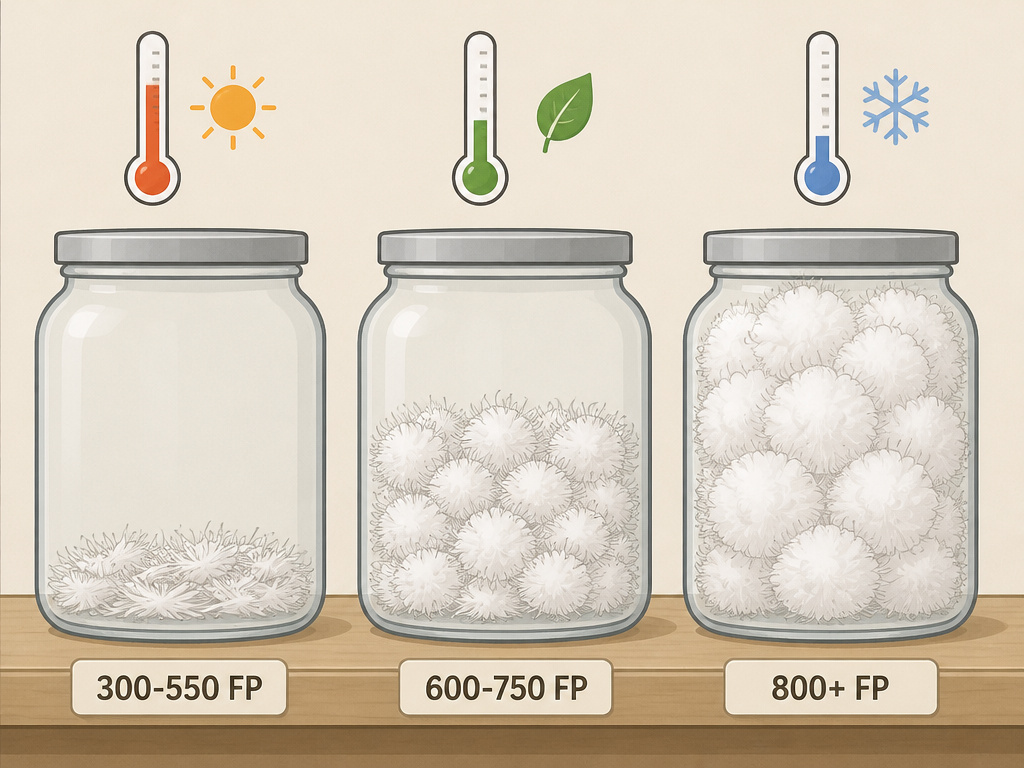
Here’s how fill power translates to real-world warmth:
300–550 fill – Best for: Summer weight or warm climates – Feel: Light, less lofty
600–750 fill – Best for: Most year-round home use – Feel: Balanced loft and weight
800+ fill – Best for: Extreme cold or weight-conscious packing – Feel: Ultra-light but lofty
The fill power vs fill weight balance is what matters, a 700-fill comforter with 30oz of down will be warmer than an 800-fill with 20oz.
Fill Power Standards and Certifications
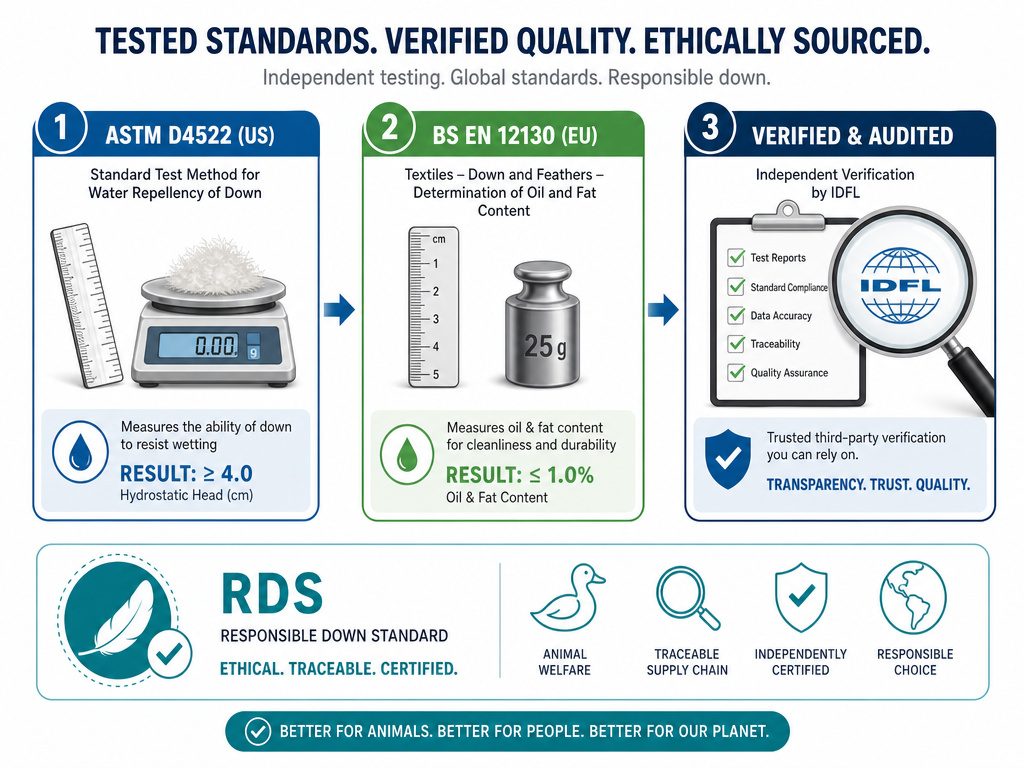
Not all fill power claims are equal. Three systems dominate:
- ASTM D4522 – US standard measuring cubic inches per ounce (1oz sample)
- BS EN 12130 – European method using millimeters per 20g sample
- IDFL Certification – Independent verification against either standard
The Responsible Down Standard (RDS) doesn’t measure fill power but ensures ethical sourcing, look for both RDS and a verifiable fill power test if ethics matter to you.
Easy to miss: Some brands label fill power based on pre-compression lab tests. IDFL studies found that some samples showed >5% variance from labeled fill power due to conditioning methods, particularly for products stored long-term in compression.
Fill Power vs. Fill Weight
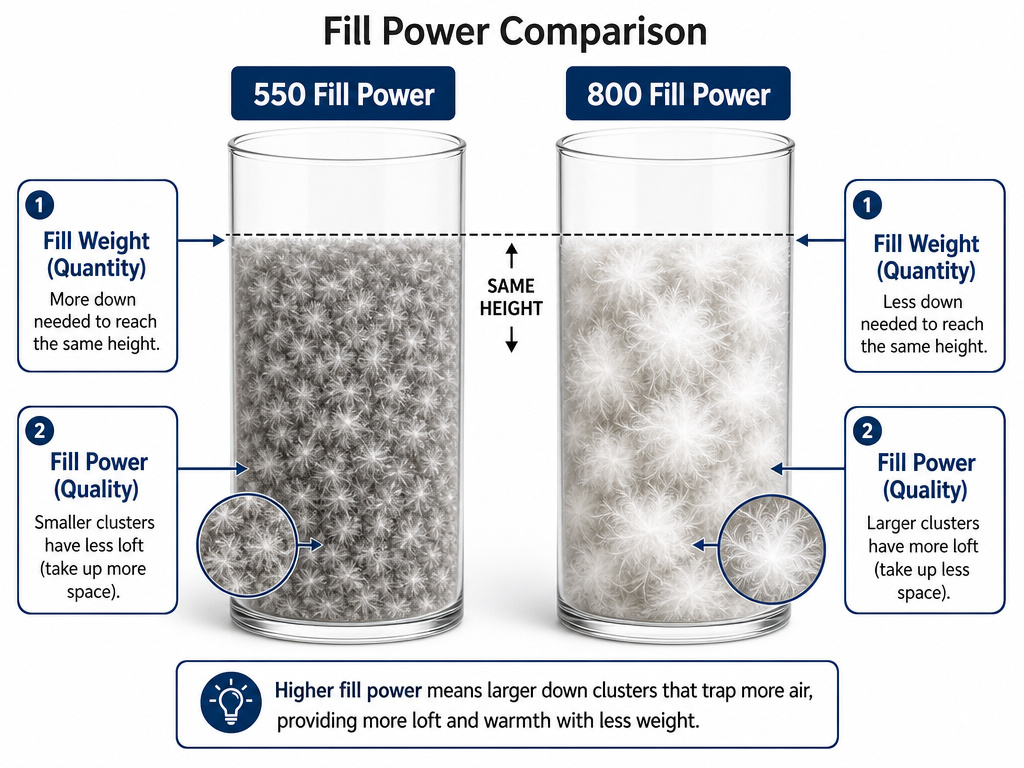
Fill power and fill weight are two different specs that work together. Fill power, which is the answer to what is fill power in down bedding, tells you how lofty and insulating a single ounce of down is. Fill weight is simply the total number of ounces of down used in the product. A high fill power means the down clusters are larger and trap more air, so you need less total weight to achieve the same warmth. For example, according to Wikipedia, a comforter using 550 fill power down would need approximately 40%-50% greater weight of down than one using 800 fill power down to provide the same loft. Think of fill power as the quality of the insulation and fill weight as the quantity.
Higher Fill Power Indicates Higher Quality
A higher fill power number directly indicates larger, more resilient down clusters. Under standardized testing, these superior clusters expand to occupy more space, trapping more insulating air. Common fill power values range from 300 to 900 cubic inches per ounce. REI states that 900 fill power is about as good as down gets, while Wikipedia notes that for sleeping bags, a lofting power of 800–950+ is considered excellent. For sleeping bags, a lofting power of 700–750 is considered very good, while 800–950+ is excellent. This metric is one of the best ways to distinguish the quality of down, as larger clusters provide better loft and warmth for less weight.
Fill Power Measures Down, Not Feathers or Synthetics
Fill power is a specific performance metric for down and feather blends, defined by standards like ASTM D4522. It measures the volume a standardized mass of down occupies. This test does not apply to synthetic insulation materials like polyester, which have their own metrics. The procedure involves placing a down sample in a climate-controlled room, then measuring its loft under pressure. Because fill power evaluates the inherent lofting ability of the down clusters themselves, it is not a relevant measure for non-down fillings.
Frequently Asked Questions
Is 800 fill power down warmer than 600?
Only if they contain the same down weight. An 800-fill comforter with 20oz of down will be less warm than a 600-fill with 30oz. The higher number means the down is more efficient, not necessarily warmer in the finished product.
What’s the best fill power for a down comforter?
For most home use, 650–750 fill power offers the best balance of cost and performance. Below 600 feels flat in a comforter; above 800 is overkill unless you need ultra-lightweight bedding for travel.
Does higher fill power last longer?
Not directly, durability depends more on down cluster size and baffle construction. However, high-fill down (700+) typically comes from older birds with larger, more resilient plumules that withstand compression better over time.
Can you restore old down’s fill power?
Yes, within limits. Washing with down-specific detergent and drying with tennis balls revives loft. But over many years, some degradation is normal even with proper care.
Before You Go
That combination delivers warmth without the premium price tag of mountaineering-grade down.
Unless you’re stuffing it into a backpack, loft matters more than the number on the tag.
