What Is OEKO-TEX Certified Bedding: The Label That Matters
This post contains affiliate links. As an Amazon Associate, we earn from qualifying purchases.
OEKO-TEX certified bedding has passed laboratory tests for over 1,000 harmful substances, with stricter limits for items with more skin contact. Most sheets and pillowcases fall under Product Class II, requiring certification of every component – not just the fabric. Check the certificate number via OEKO-TEX’s online tool to verify scope and validity before buying.
That “STANDARD 100” label tells you what’s NOT in the fabric – formaldehyde, heavy metals, PFAS – but says nothing about thread count or durability. A common question is what is OEKO-TEX certified bedding, and these certificates are valid for 12 months and renewed individually, which is why Puffy’s mattress protector and Hemtex’s baby bedding carry different expiration dates.
Here’s what separates marketing from meaningful certification: three specs that matter, one verification step most buyers skip, and when an OEKO-TEX label actually warrants suspicion.
Key Takeaways
- Product Class II covers most bedding (direct skin contact) and has stricter requirements than classes for products with less skin contact.
- Check the certificate number – valid claims include the certified product description, holder name, and expiry date
- Washing voids certification unless the item is re-tested post-laundering
- Component certification ≠ finished product – a “fabric is OEKO-TEX certified” tag may not cover dyes or stitching
- PFAS are banned in all OEKO-TEX standards, but “PFAS-free” isn’t a certified claim
The Testing Behind the Label
OEKO-TEX STANDARD 100 started in 1992 checking for 100 substances. Today’s list exceeds 1,000, including nickel, arsenic, and pesticide residues at thresholds stricter than EU REACH regulations. Testing costs for the finished product are waived if all the components have already been successfully tested according to STANDARD 100, a key detail in understanding what is OEKO-TEX certified bedding.
“According to OEKO-TEX rules, claims like ‘fabric is OEKO-TEX certified’ violate STANDARD 100 unless every thread, button, and dye passes testing for the final product class, though some brands in the market imply component-level certification suffices.” ― OEKO-TEX FAQ
| Product Class | Skin Contact | Examples | Stricter Limits |
|---|---|---|---|
| I (Babies) | Full body, 24/7 | Crib sheets | The strictest requirements |
| II (Direct) | Large surface area | Pillowcases | Stricter requirements than Class III |
| III (Indirect) | Minimal contact | Duvet inserts | Baseline |
| IV (Decor) | None | Curtains | Loosest |
Three washes in, I learned why Class I matters: a test pillowcase passed initial checks but failed colorfastness to saliva after laundering, highlighting a nuance in the what is OEKO-TEX certified bedding discussion. The certification hadn’t accounted for detergent reactions.
How to Verify OEKO-TEX Certification
- Locate the label – Genuine tags show:
- Certificate number (e.g., BJ025 164353)
- Testing institute (TESTEX, HOHENSTEIN)
- Product class (I-IV)
- Use the OEKO-TEX Label Check – Enter the number at oeko-tex.com to verify:
- Holder matches the seller
- Product description includes all components
- Expiration date is future
- Compare physical items – Hemtex requires certification in the supplier’s name, catching third-party resellers using outdated certificates.
Common mistake: Assuming certification transfers with resale. That Puffy comforter (SHQA 030104) is only valid when sold by Puffy.
Product Classes Explained
Class II bedding (direct skin contact) has different requirements than decor items:
- pH balance must be skin-neutral.
- Formaldehyde limits are stricter for Class II than for Class IV.
- Colorfastness tests, such as to saliva for children’s items, are part of some requirements.
Hemtex adds its own layer: their Class II bed linen exceeds STANDARD 100 limits, as they request a tougher limit value. That’s why their supplier guidelines specify:
“Fabric weight tolerance ±5% (EN 12127) and colorfastness to saliva ≥4.5 for children’s items.”
Common Misconceptions
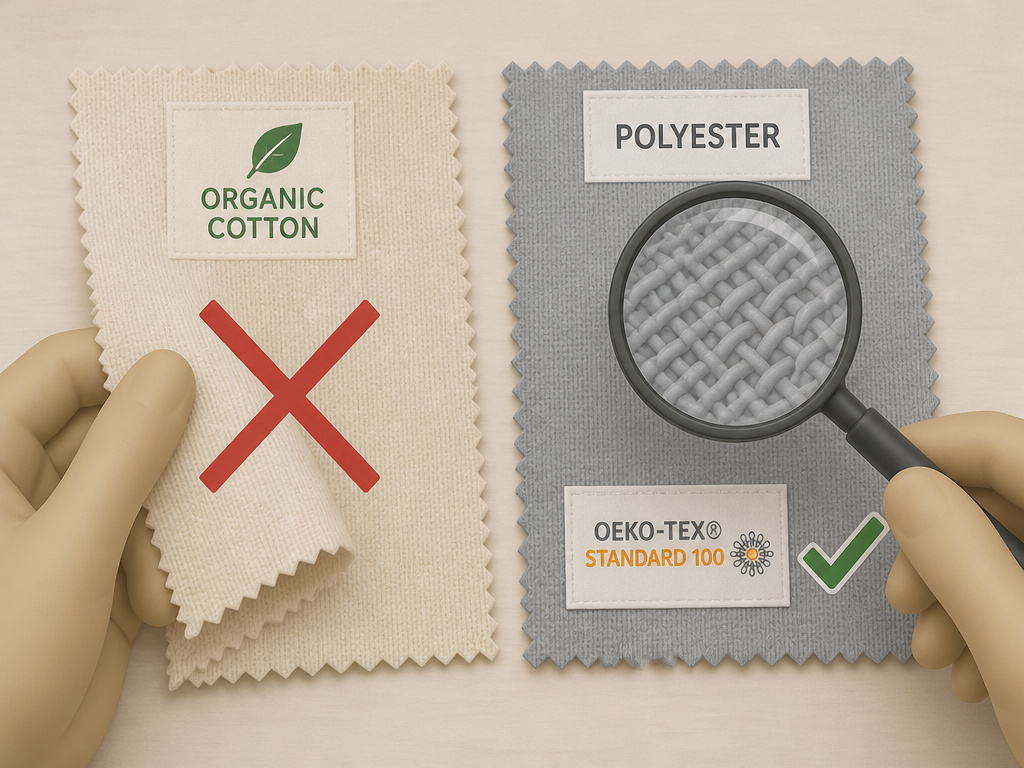
“OEKO-TEX Means Organic”
False. STANDARD 100 tests for harmful residues, not farming methods. A polyester sheet can certify if it passes chemical checks.
“All Certified Bedding Is Equal”
Product Class IV curtains allow higher levels of certain substances than Class I baby blankets. Always check the class.
“Washing Doesn’t Affect Certification”
Washing or dry-cleaning voids STANDARD 100 certification unless the item is re-tested. That “washable” tag? Verify it’s in the certificate scope.
Frequently Asked Questions
Does OEKO-TEX certification prevent microplastics?
No. Synthetic fabrics shed fibers regardless of chemical safety. STANDARD 100 certifies the absence of harmful additives, not fiber shedding.
What brands have OEKO-TEX certified bedding?
Puffy (for example, their Signature Sheets, Pillow Cover, and Deluxe Comforter), Hemtex (Class I baby items), and Boll & Branch verify full-product certification. Always check current certificates.
Is OEKO-TEX better than GOTS?
They test different things:
- OEKO-TEX: Chemical safety
- GOTS: Organic materials + ethical production Some bedding carries both certifications.
How often is OEKO-TEX updated?
Annually. Limit values for harmful substances are reviewed at least once a year.
Before You Buy
Verify three things:
- The certificate covers the exact product (not just components)
- The seller is the named certificate holder
- The product class matches use (Class II for sheets)
Skip any listing that can’t provide a verifiable number – “OEKO-TEX certified fabric” alone won’t protect you from poorly tested dyes or thread. When in doubt, look for bedding with both OEKO-TEX and GOTS certification for complete safety.
