
10 Best Pressure Care Mattresses For Long-term Care in 2026
This post contains affiliate links. As an Amazon Associate, we earn from qualifying purchases.
Our best overall pick is the Drive Medical Med Aire Plus Bariatric Mattress, chosen for its cell-on-cell design that prevents bottoming out and its comprehensive low air loss system. We also highlight the Invacare MA500 as the best clinical choice and the Drive Medical Gravity 9 for the best heel ulcer prevention.
Selecting a mattress for long-term care requires matching the technology, foam, air, or hybrid, to the patient’s specific risk level and mobility. Our research compares ten top-rated models based on their pressure redistribution features, safety functions, and real-world caregiver feedback to simplify your choice.
Top 10 Pressure Care Mattresses For Long-Term Care in the Market
Certain content that appears on this site comes from Amazon. This content is provided "as is" and is subject to change or removal at any time.
The Best Pressure Care Mattresses For Long-Term Care, Reviewed
Drive Medical Med Aire Plus Bariatric Mattress

What We Like
- Cell-on-cell design prevents bottoming out
- Digital pump with diagnostic and pillow function
- Removable bladders simplify maintenance
- Auto-return from static mode enhances safety
Trade-offs
- At 42" wide, it requires a bariatric bed frame
- Heavier than many mattresses at 36.9 lb
- Pump alarms require caregiver monitoring
With a 600 lb weight capacity and 10-inch deep cell-on-cell air bladders, this mattress is designed for bariatric patients and severe pressure ulcers up to Stage IV. The deep cells prevent bottoming out, and the system provides up to 24 hours of power outage protection, which is critical for maintaining therapy during an electrical interruption.
The trade-off is its substantial 42-inch width, which means it won’t fit a standard 36-inch home hospital bed. For a patient who doesn’t require bariatric dimensions, the Invacare MA500 microAIR offers a capable alternating pressure system in a standard width and a lighter package. But for the specific, high-weight, high-acuity scenario, the Med Aire Plus’s design and safeguards are purpose-built.
Invacare MA500 microAIR Alternating Pressure Mattress
What We Like
- Cell-in-cell design prevents bottoming out during power failure
- Natural heel slope reduces pressure on vulnerable heels
- Two-cell alternating cycle provides therapeutic pressure redistribution
- Oversized quilted cover offers low shear and moisture protection
Trade-offs
- An 8-inch height requires a compatible hospital bed frame
- At 13.5 pounds, the pump adds bulk compared to static foam
- Designed for low-medium risk, not for advanced wounds or bariatric needs
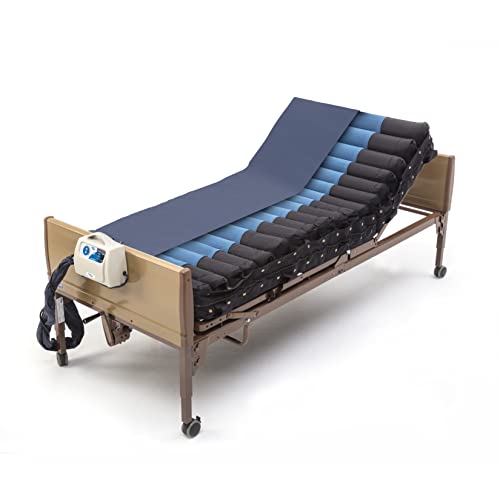
The Invacare MA500 microAIR Alternating Pressure Mattress is intended for individuals at low to medium risk of pressure sores, which means it’s designed for early-stage prevention and management. Its alternating pressure therapy works by inflating and deflating air cells in a two-cell cycle to redistribute pressure on skin surfaces and bony prominences. A cell-in-cell design helps prevent bottoming out if power fails, and a natural heel slope aims to decrease pressure in that vulnerable area. The quilted nylon top cover is vapor permeable and designed for low shear and easy cleaning.
The trade-off is its specific clinical focus. It is not a bariatric system like the Drive Medical Med Aire Plus, nor is it a simple static foam mattress like the Drive Medical Gravity 9. You choose the MA500 for its automated, fail-safe pressure therapy, not for ultra-high weight capacity or for a patient who simply needs a more comfortable static surface. It fills a defined niche between basic comfort and advanced wound care.
Drive Medical Gravity 9 Foam Mattress

What We Like
- Full-length memory foam top for comfort
- Fluid-proof, tear-resistant cover simplifies cleaning
- Articulation cuts in base extend mattress life
Trade-offs
- Weighs 23 pounds, a two-person lift for rotation
This mattress suits caregivers who need a reliable, maintenance-free foam surface that actively works to prevent one of the most common and stubborn types of pressure injuries. Its fluid-proof cover and straightforward construction mean you spend time on care, not on managing a pump or complex settings.
This is a static foam design, so it lacks dynamic pressure redistribution. Unlike the Invacare MA500 microAIR Alternating Pressure Mattress, it redistributes weight passively. That makes it a simpler, quieter choice, but it won’t periodically shift pressure points for someone who cannot reposition themselves at all.
ProHeal Low Air Loss Alternating Pressure Mattress
What We Like
- Cell-on-cell base holds air for 4" during power loss
- Multiple alarms for low pressure, power, and alternating failure
- CPR valve allows for rapid emergency deflation
- Four customizable alternating cycles for tailored therapy
Trade-offs
- At 30 lb, it is heavier than some 36" air mattresses
- Requires a standard 36" hospital bed frame for proper fit
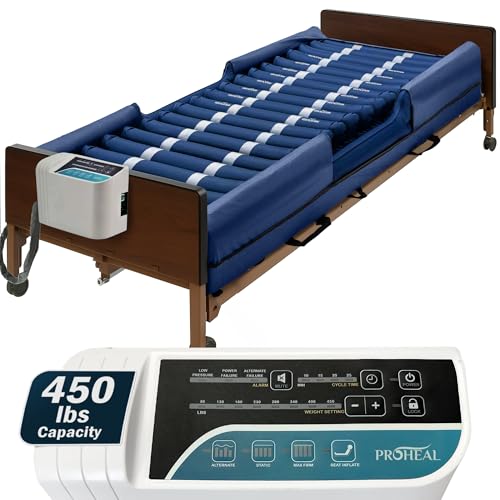
The ProHeal’s combination of 20 alternating air cells and 18 laser-cut low air loss holes creates a system designed to manage both pressure and moisture, which is the core challenge in long-term wound care. This makes it a strong candidate for a patient whose skin is at risk from both immobility and a damp microclimate, where a standard alternating mattress might not be enough.
That clinical focus comes with some practical considerations. It’s a dedicated medical system, heavier than simpler pad-style toppers, and needs the right bed frame. For someone who primarily needs pressure relief without the moisture concern, a foam option might be simpler. But for the specific problem of keeping skin dry while redistributing weight, the ProHeal’s specifications are built for the task.
Product photos
Invacare Solace Hospital Bed Mattress
What We Like
- Deep fortress-cut cells for superior airflow
- Three-zone firmness for targeted body support
- Dual-layer foam prevents painful bottoming out
- Welded waterproof zipper for maximum fluid control
Trade-offs
- Six-inch height may require deep-pocket sheets
- At 25 pounds, repositioning requires more effort
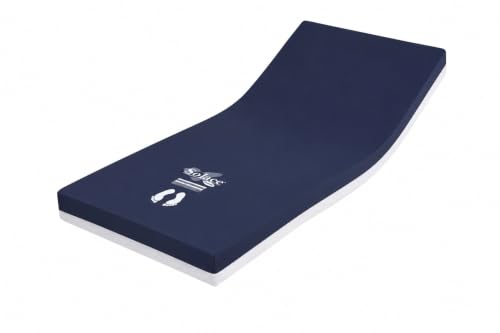
The 3-zone targeted firmness is the core of this mattress, delivering a firm 40.5 IFD under the hips where pressure is most critical. That medical-grade support, combined with a lighter-firm zone for the heels, creates a precise balance that actively works to maintain alignment and redistribute weight. It’s built for a patient who needs consistent, zoned pressure relief without the complexity of a powered system. The deep fortress-cut cells and two-way stretch cover work together to minimize shear and keep skin cool, which is crucial for long-term care.
It’s a dedicated pressure-redistribution surface, not a dynamic therapy system. For someone whose primary need is stable, zoned support with excellent breathability, this is a strong contender. If the care plan requires active pressure cycling, a system like the Invacare MA500 microAIR, with its alternating air cells, would be the necessary step up. This mattress excels by doing one job exceptionally well.
Product photos
Kölbs Pressure Redistribution Foam Mattress

What We Like
- High-density foam for even weight distribution
- Non-slip underside secures mattress on bed
- Fire-retardant and safety compliant
- Waterproof cover simplifies cleaning
Trade-offs
- 80-inch length excludes standard 75-inch twin beds
A 5.5-inch profile of high-density foam creates a firm, stable surface that redistutes weight effectively, which is the core requirement for preventing pressure buildup in long-term care. This makes it a straightforward choice for caregivers needing a reliable, maintenance-free foundation, particularly where adjustable bed frames are in use. Its fire-retardant construction and secure, non-slip base add layers of safety for both home and institutional settings.
This mattress relies on high-density foam to redistribute weight, a passive approach suitable for general pressure relief rather than active alternating systems. Its design omits a pump, simplifying setup and maintenance for caregivers. The focus is on straightforward, durable support for compatible 80-inch medical bed frames.
Product photos
VOCIC Alternating Pressure Mattress Pad
What We Like
- Ultra-quiet ceramic pump for undisturbed sleep
- Six adjustable pressure levels for firmness customization
- Long 15-inch securing flaps prevent sliding
- Includes repair kit for puncture maintenance
Trade-offs
- 33.5-inch width is narrower than most hospital-grade mattresses
- No low air loss feature to manage moisture and heat
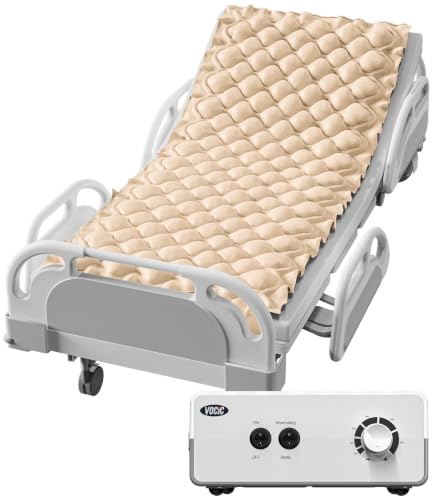
The VOCIC pad’s upgraded ceramic pump runs under 45dB, which the manufacturer describes as whisper-quiet for undisturbed sleep. This low noise level makes it a practical consideration for home care where minimizing nighttime disturbance is a priority. The dual modes add flexibility, allowing a switch to a static, movement-free surface if the alternating motion is not preferred, suiting users sensitive to bed movement as much as to pressure.
The pad’s 33.5-inch width is narrower than many full mattress systems like the 36-inch wide Invacare MA500, positioning it as a topper rather than a complete mattress replacement. For someone needing a comprehensive, high-capacity pressure management system, a full mattress may be the better route. For adding quiet, adjustable pressure relief to an existing bed without overhauling the entire setup, this pad serves that specific purpose.
Product photos
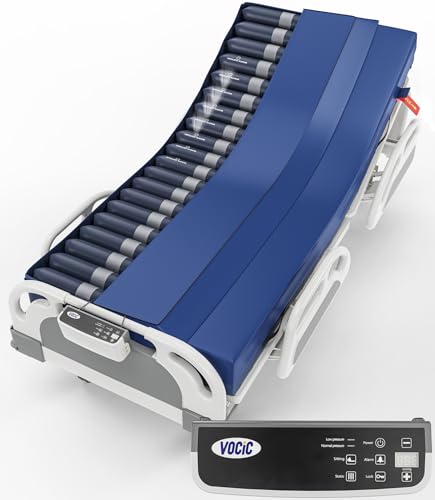
VOCIC Dual-Layer Smart Mattress System
What We Like
- Dual-layer 20-tube design for deep pressure redistribution
- Smart pump with three alternating modes and static support
- Built-in low air and power failure alarm
- Breathable back ventilation for moisture management
Trade-offs
- The 8-inch height may require a bed rail for safe transfers
- No low air loss feature for active moisture wicking
A 507-pound weight capacity and a dual-layer air tube system provide a level of pressure redistribution that single-layer pads can’t match, making it a strong candidate for long-term care of heavier individuals. The integrated smart pump adds thoughtful care features, like one-touch static mode for repositioning and a sitting support mode, which adapts the surface for meals or reading. It suits a caregiver looking for an all-in-one alternating pressure system that prioritizes ease of use and alarm-based safety over manual monitoring.
Its 33-inch width is several inches narrower than standard hospital bed mattresses like the Invacare MA500. This can leave gaps at the sides of the bed frame, which is a consideration for safety and stability. Compared to a dedicated low air loss system like the ProHeal Low Air Loss Alternating Pressure Mattress, the VOCIC relies on passive back ventilation rather than actively pulling moisture away. That’s a point to weigh if managing heat and humidity is a primary concern.
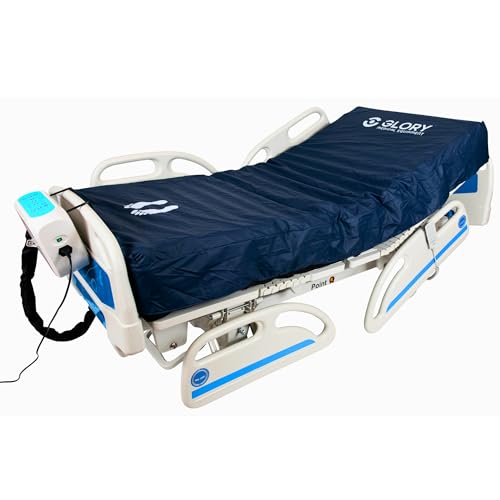
HopeFULL Glory MA-9T Mattress
What We Like
- Complete package includes repair kit and storage bag
- CPR valve allows for fast emergency deflation
- Waterproof, breathable cover is removable for cleaning
- Quiet pump operation minimizes sleep disruption
Trade-offs
- 35-inch width is narrower than several common 36-inch alternatives
- 26-pound weight exceeds some air mattress systems like the 13.5-pound Invacare MA500
The HopeFULL Glory MA-9T uses a 20-chamber alternating inflation and deflation cycle, a system designed to distribute pressure evenly for a patient lying in one position. According to its description, this helps improve circulation, reduce pressure points, and support patients with long-term care needs. The package includes a repair kit and a portable storage bag among its accessories.
At 35 inches wide, the mattress is narrower than several comparable models like the 36-inch Invacare MA500 or the 42-inch Drive Medical Med Aire Plus Bariatric mattress. This width difference is a key comparison point for users matching a mattress to their specific bed frame. The system comes with an electric pump, adjustable settings, and a CPR valve, aiming to provide a complete package for home care.
Product photos
ProHeal Memory Foam Hospital Mattress

What We Like
- Sloped heel design to redistribute pressure from heels
- Removable, waterproof cover with 360-degree zipper
- Multi-tiered foam zoning for targeted pressure relief
Trade-offs
- Static foam design lacks alternating pressure.
- Cover warranties last only 2 years.
With a 1000 lb capacity, the ProHeal Memory Foam Hospital Mattress accommodates heavier loads than many static foam alternatives. Its design uses high-density die-cut foam for the torso and head, paired with open-cell memory foam in a sloped heel section, to redistribute pressure from vulnerable areas. This construction targets moderate to high-risk patients needing pressure relief without mechanical assistance.
The substantial capacity and soft feel come from a static foam construction. It won’t actively cycle pressure like the Invacare MA500 microAIR or provide the microclimate control of a low air loss system. For a patient who needs to be turned regularly or who runs hot, the ProHeal relies on its breathable, washable cover rather than active air circulation. It stands as a durable, high-weight foam option in a field where many comparable foam models have lower weight limits.
Product photos
How We Evaluated Pressure Care Mattresses
Our evaluation was research-based, focusing on manufacturer specifications, clinical guidelines for pressure injury prevention, and patterns in owner feedback from care settings. We prioritized systems that actively redistribute pressure, such as alternating air cycles or zoned foam, and assessed crucial safety features like CPR valves and power-failure backup. We also weighed practical factors for long-term use, including mattress weight for rotation, cover cleanability, and pump noise levels.
A key limit of our research-led method is that we cannot verify the precise clinical outcomes for individual patients. We relied on documented product specifications and reported caregiver experiences rather than hands-on medical testing. For detailed information on systems designed for pressure ulcer prevention, our related guide offers further insight.
What To Look For In Pressure Care Mattresses
The right mattress depends on the patient’s mobility, risk level, and care environment. Core technologies range from static high-density foam to dynamic alternating air systems with low air loss.
Key criteria are the pressure redistribution technology (alternating air, low air loss, or zoned foam), safety features for power failure and emergencies, and practical details like weight, cover type, and bed frame compatibility.
Pressure Redistribution Technology
Alternating pressure mattresses use a pump to cycle air between groups of cells, shifting pressure points over time. This is ideal for completely immobile patients. Low air loss systems add a constant flow of air across the surface to manage moisture and heat, which is critical for managing both pressure and skin maceration. For patients with some mobility, high-density or memory foam mattresses with zoned firmness or sloped heels provide passive, reliable support without a pump.
Safety & Redundancy Features
For powered systems, look for a CPR valve for rapid deflation in an emergency and a battery or cell design that maintains support during a power outage. Many clinical-grade systems have a “cell-in-cell” or “cell-on-cell” base that holds several inches of air if the pump fails. Audible alarms for low pressure or pump failure are essential for caregiver monitoring, especially overnight.
Fit & Practical Maintenance
Ensure the mattress width matches your bed frame; common medical bed widths are 36 inches, while bariatric models are wider. A removable, waterproof, and breathable cover is non-negotiable for infection control and ease of cleaning. Consider the total weight of the system, as heavier mattresses require two people to rotate for even wear.
- Check the mattress height to ensure it works with your bed rails and doesn’t create a fall risk.
- Verify pump noise levels if the patient is sensitive to sound during sleep.
- Look for included accessories like repair kits or storage bags for long-term value.
The most advanced system is only effective if it fits the bed frame and the caregiver can manage its upkeep.
Pressure Care Mattresses For Long-Term Care Compared
The table below compares key specifications across our top picks to help you see the differences at a glance.
| Product | Mattress Type | Cover Material | Dimensions (LxWxH) |
|---|---|---|---|
| Drive Medical Med Aire Plus Bariatric Mattress | Low Air Loss Alternating | N/A | 80" x 42" x 10" |
| Invacare MA500 microAIR Alternating Pressure Mattress | Alternating pressure system | Vapor-permeable quilted nylon | 80" x 36" x 8" |
| Drive Medical Gravity 9 Foam Mattress | Pressure Redistribution Foam | Fluid proof, low shear | 80" x 36" x 6" |
| ProHeal Low Air Loss Alternating Pressure Mattress | Low Air Loss Alternating | Fluid resistant, non-shear nylon | 80" x 36" x 8" |
| Invacare Solace Hospital Bed Mattress | Therapeutic Foam | 2-way stretch waterproof | 84" x 36" x 6" |
| Kölbs Pressure Redistribution Foam Mattress | Pressure Redistribution Foam | Waterproof, removable | 80" x 36" x 5.5" |
| VOCIC Alternating Pressure Mattress Pad | Alternating Pressure | N/A | 74.8" x 33.5" x 8.3" |
| VOCIC Dual-Layer Smart Mattress System | Alternating Air Pressure | Machine washable | 79" x 33" x 8" |
| HopeFULL Glory MA-9T Mattress | Low Air Loss Alternating | Breathable, waterproof | 78" x 35" x 7" |
| ProHeal Memory Foam Hospital Mattress | Memory Foam | Removable waterproof nylon | 80" x 36" x 6" |
Frequently Asked Questions
Does Medicare cover pressure reducing mattresses?
Medicare Part B may cover a pressure-reducing mattress if it is deemed medically necessary by a doctor to treat or prevent pressure ulcers. Coverage typically requires documentation of the patient’s condition and that the mattress is prescribed for use in the home. It’s crucial to check with the supplier and Medicare for the most current eligibility requirements and any necessary paperwork.
What is the best hospital mattress to prevent bed sores for elderly patients?
The best mattress depends on the patient’s risk level. For low to medium risk, a high-density foam mattress like the Kölbs Pressure Redistribution Foam Mattress can be effective. For higher risk or immobile patients, an alternating pressure system like the Invacare MA500 or a low air loss mattress like the ProHeal is often recommended to actively shift pressure and manage moisture.
What kind of mattresses do nursing homes use?
Nursing homes commonly use a mix of high-density foam mattresses for general care and alternating pressure or low air loss systems for residents at high risk for pressure injuries. Clinical-grade models like the Drive Medical Med Aire Plus are designed for facility use, featuring durable construction, safety alarms, and easy-to-clean surfaces to meet infection control standards.
What type of mattress is best for pressure relief?
An alternating pressure air mattress is generally considered best for active pressure relief, as it constantly shifts support points. For a non-powered option, a high-density foam mattress with zoned firmness or a sloped heel design offers excellent passive relief. The choice ultimately hinges on the patient’s mobility and whether moisture management is also a concern.
How important is a waterproof cover on a care mattress?
A waterproof cover is absolutely critical. It protects the mattress core from fluids, simplifies cleaning, and helps maintain a hygienic environment to prevent infection. Look for covers with welded seams and breathable materials to balance protection with patient comfort, as seen on models like the Invacare Solace Hospital Bed Mattress.
The Bottom Line
This low air loss system is a top choice for bariatric patients or those with advanced pressure care needs, fitting well in a clinical or well-equipped home setting. Its safety features provide significant protection. For a tighter budget or lower-risk patients, high-value foam options like the Drive Medical Gravity 9 for heel protection or the Kölbs for general pressure redistribution are worth considering.
Regardless of your choice, the single most important factor is matching the mattress’s technology to the patient’s specific risk level and care environment. A system that provides the right support while being practical for caregivers to maintain will offer the best long-term protection and comfort.
